Restoration
Water Damage Restoration
Water does not stop at the surface. It wicks up drywall, travels along joists and sits in the subfloor long after the carpet feels dry. We extract it, dry the structure properly, and document every reading so your insurer sees exactly what happened.
24/7 Emergency Response
Water coming in right now?
Mold can start on damp material within 24 to 48 hours. The sooner extraction and drying begin, the less has to be torn out and rebuilt.
Call any hour. Someone picks up.
The Problem
The damage keeps moving while you decide.
A supply line lets go, a water heater fails, or a storm pushes water under a door. Within 24 to 48 hours, damp drywall and framing become somewhere mold can grow. The clock starts the moment the water arrives.
What the job includes
- Emergency response, 24 hours a day
- Truck-mounted and portable water extraction
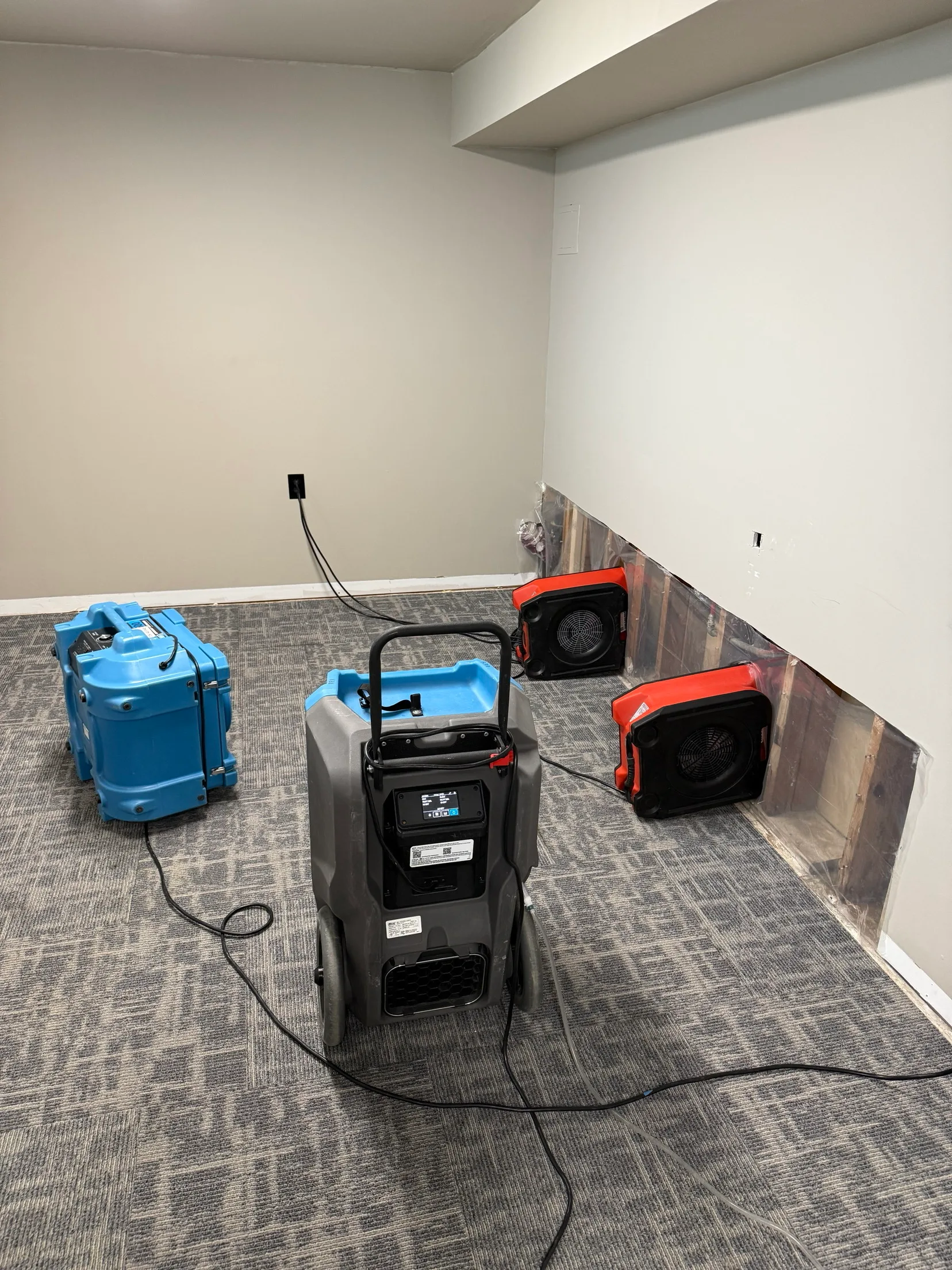
- Structural drying with LGR dehumidifiers and air movers
- Moisture mapping and daily readings until the structure hits dry standard
- Documentation formatted for insurance adjusters
- Controlled tear-out of unsalvageable materials
How It Goes
Step by step.
- 01
Stop the source and assess
Before anything else the water has to stop. We then map the full extent with moisture meters and thermal imaging, because the wet area is almost always larger than the visible stain.
- 02
Extract standing water
Standing water comes out first. The faster it is gone, the less migrates into materials that would otherwise have to be removed.
- 03
Controlled tear-out
Saturated carpet pad, swollen baseboard and crumbling drywall cannot be dried back to a sound condition. We cut back only what has to go, and we cut clean lines so the rebuild is straightforward.
- 04
Dry the structure
Air movers keep moisture evaporating off surfaces while dehumidifiers pull it out of the air. Placement is calculated for the room rather than guessed at. Put them in the wrong spot and all you do is push damp air around.
- 05
Monitor to dry standard
We take readings every day and keep drying until the materials match the dry standard for your building, not until the equipment has been running an arbitrary number of days.
- 06
Hand over documentation
You receive the moisture log, photographs and scope of work. That record is what an adjuster needs in order to approve a claim without argument.
Questions
Water Damage Restoration: what people ask.
How quickly do you need to get there?
As fast as possible. Mold can begin growing on damp organic material within 24 to 48 hours, and the difference between a same-day response and a three-day wait is often the difference between drying a room and gutting it.
Will my insurance cover this?
Sudden and accidental water damage is commonly covered. A burst pipe or a failed appliance hose usually qualifies. Gradual leaks and flooding from outside usually are not, and flooding typically needs separate flood insurance. We document the loss thoroughly either way so your adjuster has what they need, but the coverage decision is your insurer's to make, not ours.
Can I just dry it out with fans myself?
Household fans move air but remove no moisture from it. Without dehumidification you are often just relocating the damp into other materials. For a small spill on a hard floor, fans are fine. For anything that has soaked into drywall, insulation or subfloor, they are not.
How long does drying take?
Typically three to five days for a contained loss, longer where water has reached insulation or hardwood. We monitor daily and remove equipment when the readings say the structure is dry.
Free Estimate
Get a price for water damage restoration.
Tell us roughly what you are dealing with and we will come back with a real number, not a placeholder.
Also From Us